Engine Carbon Cleaning in Wigan — the service we built Panache on
Panache Tuning started life as a mobile carbon-cleaning business back in 2014. It’s still one of the most cost-effective services we offer for restoring throttle response, protecting the DPF and EGR, and keeping a modern diesel running properly for the long term health of your engine.
When a carbon clean is actually worth doing
Throttle response feels sluggish
The engine feels doughy, hesitates on pick-up, and has lost its sharpness. This is classic carbon build-up on the inlet valves, intake runners and EGR, where the engine is literally breathing through a restriction it shouldn’t have.
MPG has crept down over time
A gradual drop-off in fuel economy that no normal service has been able to cure. Carbon deposits alter fuel-air mixing, ignition timing and airflow, and all those small hits add up over time.
High-mileage or short-journey daily use
City driving, short commutes and school-run cycles all stack the deck against your engine. Modern diesels and direct-injection petrols carbon up faster under this kind of pattern than the engineers ever intended. A carbon clean is genuinely preventative work in these cases.
Pre-empting DPF or EGR problems
Heavy soot production is what clogs DPFs and seizes EGR valves over time. A proper intake-side clean reduces upstream soot and buys the DPF and EGR real time. Much cheaper than fixing the downstream fault after it’s already happened.
Why carbon build-up matters more on a modern engine than an old one
Older engines had port injection, which sprayed fuel across the valves on the way in and effectively rinsed them every stroke. Modern direct-injection engines, both diesel and GDI petrol, inject fuel past the valve, so the valves never get washed. Combine that with EGR recirculating exhaust gas into the intake, crankcase breathers dumping oil vapour, and typical short-journey driving, and carbon builds up surprisingly fast inside the engine.
What the carbon does
- Coats the intake valves — rough, porous layer that disrupts airflow and changes the intake geometry
- Narrows intake runners — especially visible in dismantled VAG TDi and BMW N47/N57 intakes
- Seizes the EGR valve — exhaust recirc plus soot = thick paste that stops the valve moving
- Loads the DPF faster — heavier soot output reaches the filter sooner
- Fouls injector tips — poor atomisation, uneven burn, more soot, the cycle repeats
- Drops compression slightly over time as valves don’t seat cleanly
What you feel
- Poor throttle response from a standstill or mid-range
- Slower acceleration at motorway overtaking speeds
- Lower MPG vs the same drive cycle a year ago
- Rougher idle, occasional hesitation on cold starts
- Engine feeling “tired” before the mileage really says it should
How a carbon clean with us works
Quick diagnostic first
We connect the scanner first and take a baseline reading. Fuel trims, MAF reading, EGR position, and on diesels the DPF soot and ash loads. We want to know where the engine is before we clean it, so we can show you where it ended up after.
Visual check
A quick under-bonnet look, where we check oil condition, air filter state, crankcase breather and any obvious vacuum or boost leaks. Cleaning the intake is wasted money if there’s a live mechanical fault dumping fresh carbon in faster than we can clean it out.
Hydrogen + chemical clean
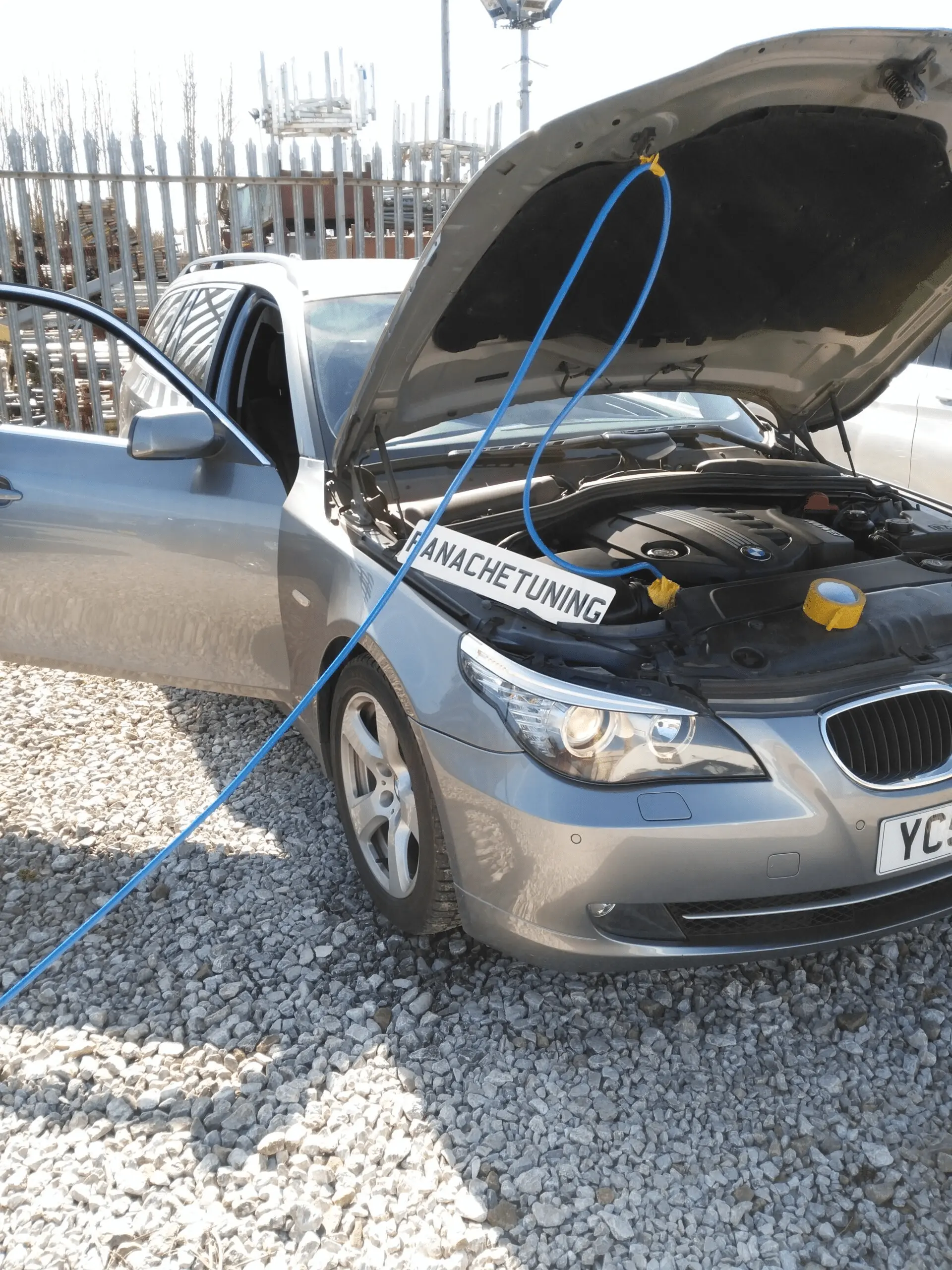
We introduce hydrogen through the intake at controlled concentrations, combined with a carbon-targeted chemical treatment where appropriate. The extra combustion energy breaks down and burns off the carbon on inlets, valves, piston crowns and EGR, and on diesels into the DPF where the increased exhaust temperature helps promote a regen at the same time.
Post-clean live-data check
We re-scan and compare the live data: fuel trims, MAF, EGR position response and DPF soot load. You get to see the before-and-after on the scan tool, not just hear a claim from us.
Honest sign-off
If the clean has made the difference we expected, great. If the numbers haven’t moved much, which sometimes happens on very high-mileage or heavily carbonned engines where a clean alone isn’t enough, we’ll tell you straight what the next step would be.
Typical time in the workshop is 45–90 minutes · Mobile carbon cleaning is available with the same process and tools, at your address.
Why it’s worth doing properly
This is where we started — 2014
Panache Tuning began as a mobile carbon-cleaning service back in 2014. We’ve run thousands of these cleans over the last 12 years, across pretty much every common diesel and direct-injection petrol platform you can think of. If anyone in Wigan has done more of these, we’d genuinely like to meet them.
Diagnostic-first, not a universal “cure”
We’re not going to tell you a carbon clean will fix every engine problem, because it won’t. What it will do on the right car or van with the right driving profile is measurably improve throttle response, recover lost MPG, and slow the carbon-driven wear on your DPF and EGR. If your engine’s problem is something else entirely, we’ll tell you that instead and save you the money.
Mobile or workshop
Same clean, same equipment, whichever suits you best. Drive to us at 186b Manchester Road or book a mobile visit, with most of Wigan, Skelmersdale, Ormskirk, Leigh, Chorley and St Helens covered.
When a carbon clean isn’t the answer
A carbon clean is a preventative and restorative service, not a cure-all. At Panache Tuning we’d rather save you £100 than watch you spend it on the wrong fix.
When it genuinely helps
- High-mileage diesels running a stop-start city cycle
- Direct-injection petrols with 60k+ miles that feel flat
- Pre-emptive maintenance before DPF/EGR issues develop
- Regular interval (every 30–40k miles) as part of a long-ownership maintenance plan
- After a remap, to make sure the intake side is clean and optimised
When it probably won’t move the needle
- Mechanical fault is the real issue — injector, turbo, boost leak, compression
- DPF is already severely blocked — needs cleaning/regen work, not an intake clean
- EGR is seized solid — carbon clean alone rarely frees a fully stuck valve; see the EGR service
- Very low mileage or already-clean engine — little to clean, little to gain
- Gearbox / drivetrain symptoms — a proper scan will separate them
If we think yours is in the second category, we’ll tell you before you book, not after we’ve taken your money. Give us a call on 07597 921326 and describe the symptoms, and we’ll be honest about whether a clean is the right answer for your car or van.
What it costs
We price carbon cleaning by the engine size and vehicle type, not per hour.
| Job | Typical price | Notes |
|---|---|---|
| Petrol / diesel car — up to 2.0L | £70–£100 | Workshop. Includes pre/post scan |
| Petrol / diesel car — 2.1L and above | £80–£120 | Workshop. Includes pre/post scan |
| Vans & LCVs (Transit, Sprinter, Vivaro, Crafter) | £80–£120 | Workshop or mobile |
| Combined with DPF clean or EGR clean | Bundle discount | Ask when booking — we’re happy to package when it makes sense |
These prices are typical ranges, not fixed quotes. Give us a call on 07597 921326 for a firm number once we know the exact vehicle. Finance is available on the larger bundles.
Reviews from carbon-clean customers
“Excellent service, quick, efficient and a real difference to the vehicle. The vehicle runs infinitely better — improved the MPG by around 10–15% overall and the throttle response is considerably better. Now drives like a new vehicle.”
“Just had a remap done and carbon clean done — it’s like my car has a new lease of life, and the extra power is mint. Very friendly and easy to talk to. Would recommend to anyone.”
“Van and car carbon cleaned by Ste — MPG shot up. Acceleration feels smoother with more pull.”
“Had a carbon clean this morning — great service, turned up promptly. Service was excellent and professional and has made the throttle response much better and the car run a lot smoother through the whole rev range. Would highly recommend!”
Questions we get asked
Does carbon cleaning actually work, or is it marketing?
On the right engine with the right driving profile, yes it does, measurably. We pre-scan and post-scan so you can see the fuel trim, MAF and EGR position changes yourself. On the wrong engine, like a very new car, a very low mileage example, or one where the real fault is mechanical, honestly no it doesn’t. Which is exactly why we’ll tell you up front whether yours is worth doing.
How often should I carbon clean?
On a diesel doing 15k+ miles a year of mixed motorway and town driving, every 30–40k miles is sensible preventative maintenance. Short-journey city driving more often, every 20–25k miles. Direct-injection petrols every 40–60k miles. Very low-mileage cars with long motorway runs rarely need it at all.
Will it damage my engine?
No it won’t. Hydrogen carbon cleaning burns off existing carbon deposits using the engine’s normal combustion cycle. There’s nothing abrasive involved and no mechanical intervention inside the engine. We’ve done this across thousands of vehicles with no incidents on our end.
Will it pass an MOT smoke test afterwards?
A cleaner-running engine generally means lower smoke numbers. If you’re borderline on an MOT emissions test, a carbon clean will often get you through. It’s not a guaranteed MOT fix because if there’s a real mechanical fault causing high smoke, cleaning alone won’t patch that, but it’s a legitimate thing to do pre-MOT on a high-mileage diesel.
Can you do it at my house?
Most of the time, yes we can. We’ll need the car or van stationary and running for about an hour, on the driveway or a safe road. Mobile coverage includes Wigan, Leigh, Ashton, Standish, Hindley, Platt Bridge, Orrell, Skelmersdale, Ormskirk, Chorley and St Helens. Give us a call with your postcode if you’re outside that list.
Will it help my DPF or EGR?
Yes it will, by reducing the soot being produced upstream, which is what’s clogging the DPF and seizing the EGR over time. It’s preventative work for both. If either is already badly blocked, a carbon clean on its own won’t fix the blockage, but it helps stop the next one. Have a look at the DPF and EGR pages if you’re already at that point.
Does it help petrol cars too?
Yes it does, particularly direct-injection (GDI) petrols, which have the same intake-carbon problem as diesels because the fuel never washes the valves. Older port-injection petrols gain less because the valves already get cleaned by the fuel spray every stroke.
Will it affect my car’s warranty?
No it won’t. It’s a non-invasive clean with no fluid going into the oil and no physical components removed or altered. Shouldn’t trigger any warranty concern from the manufacturer’s side.
Spread the cost on bundled work
A carbon clean on its own is usually a one-off payment, but if you bundle it with DPF or EGR work then finance is available:
- Klarna — 3 interest-free payments
- PayPal Pay in 4 — 4 interest-free payments
- Payment Assist — longer terms, 0% available on larger jobs
Want it running like it should? Let’s clean it properly.
Bring your car or van into the workshop, or give us a call and we’ll talk through whether a carbon clean is the right answer for your specific vehicle and driving profile. Honest advice, no upsell.